
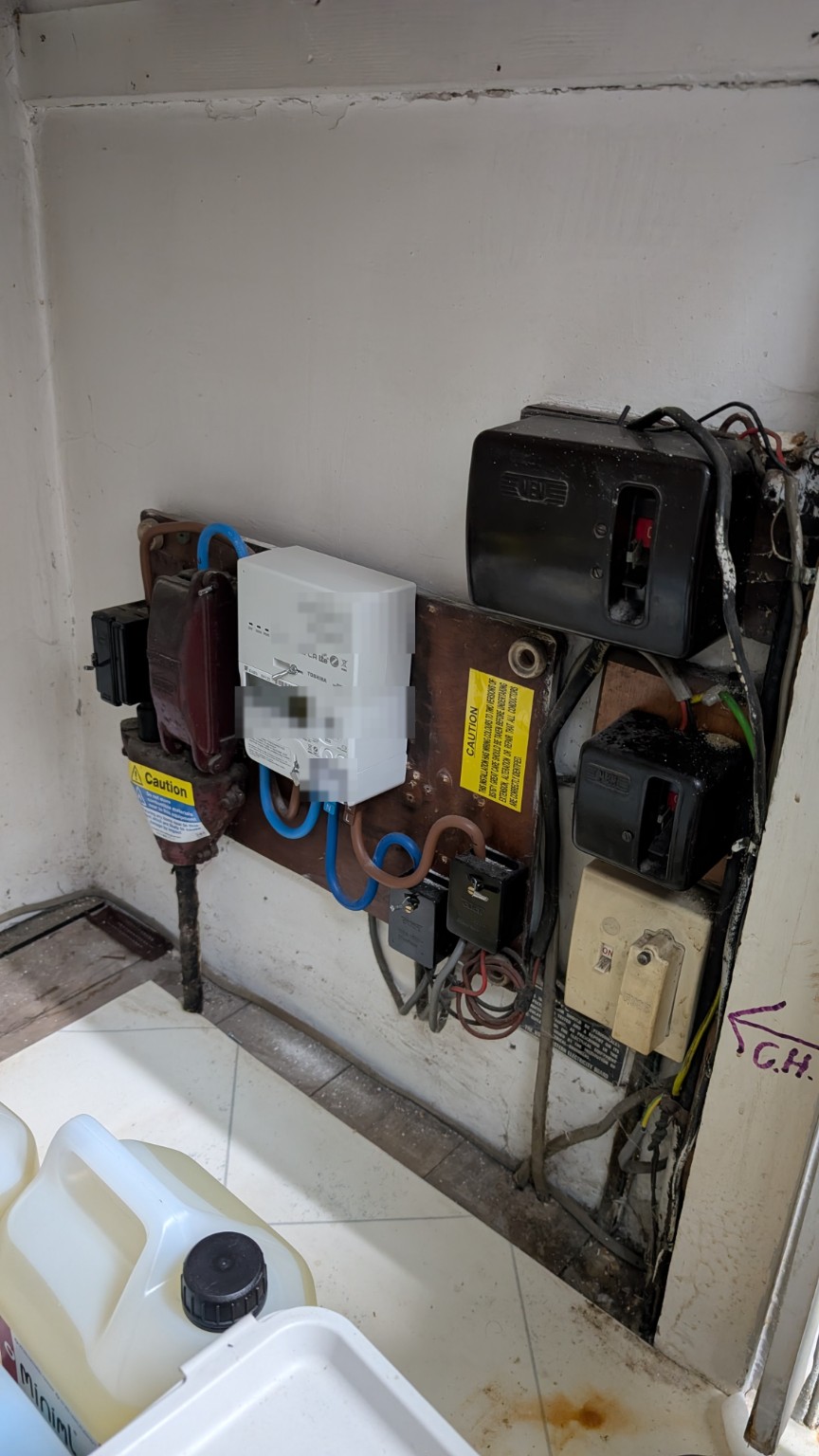
One of the early decisions in the design process was what to do with our electricity supply. When we moved in, the house needed a full rewire because the electrics were likely not to have been substantially updated since the 1970s. The service cut-out fuse was very old and needed renewing, while the consumer unit was outdated and unsafe. The location was also highly inconvenient. Both the service cut-out fuse and consumer unit were under the stairs on the ground floor, exactly where we hoped to create a new WC. We therefore needed to decide not only how to renew the electrical installation, but whether this was the right moment to improve the incoming supply as well.
1. What were our options for the electrics?
Initially, we had two obvious options:
- Keep the supply where it was and have Northern Powergrid replace and upgrade the old service fuse free of charge.
- Move the supply to a more convenient location through Northern Powergrid and upgrade the fuse at the same time.
Either way, we still needed a new consumer unit and a full rewire of the house.
It was only later that we realised there was a third option: move the supply and upgrade from single phase to three phase at the same time. That turned out to offer a significant infrastructure upgrade for a relatively modest additional cost, particularly when considered alongside the wider electrical system we were already planning for the house.
2. What does single phase actually mean?
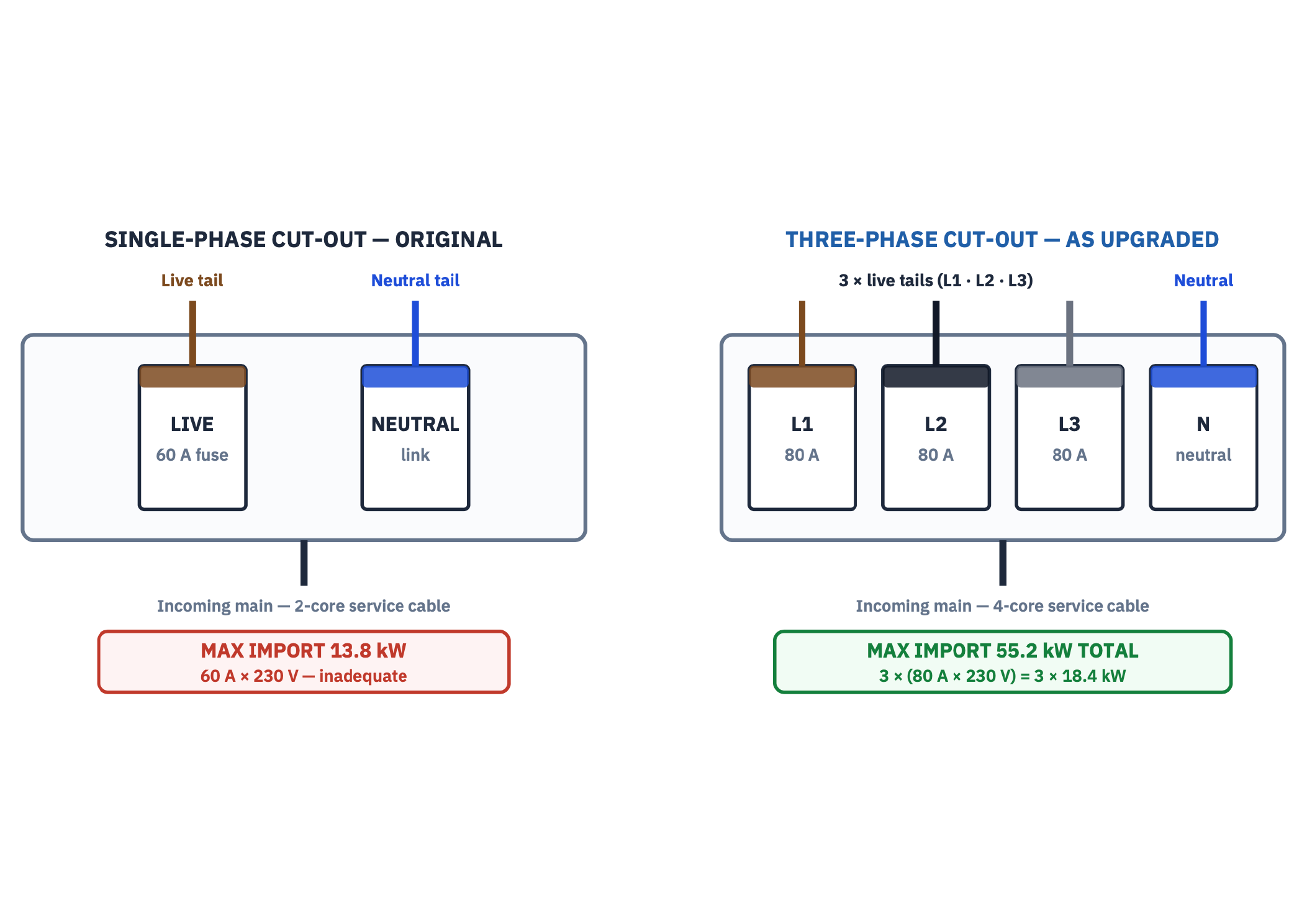
The vast majority of UK homes have a single-phase electricity supply: one incoming live wire, one neutral wire and a single main cut-out fuse where the electricity enters the house. The main cut-out fuse limits how much current the house can pull from the grid. Domestic service fuses are commonly rated at 60 A, 80 A or 100 A. Using 230 V as the nominal voltage, the maximum power available is voltage multiplied by current:
Power (watts) = Current (amps) × Voltage (volts)
Our existing supply had a very old 60 A service fuse, giving a theoretical maximum import capacity of 13.8 kW. An 80 A single-phase supply would provide approximately 18.4 kW, while a 100 A supply would provide approximately 23 kW.
| Main fuse rating | Nominal voltage | Maximum import power | Status at our house |
|---|---|---|---|
| 60 A | 230 V | 13.8 kW | Original existing setup |
| 80 A | 230 V | 18.4 kW | Possible single-phase upgrade |
| 100 A | 230 V | 23.0 kW | Typical upper domestic single-phase rating |
3. What changes with three phase?
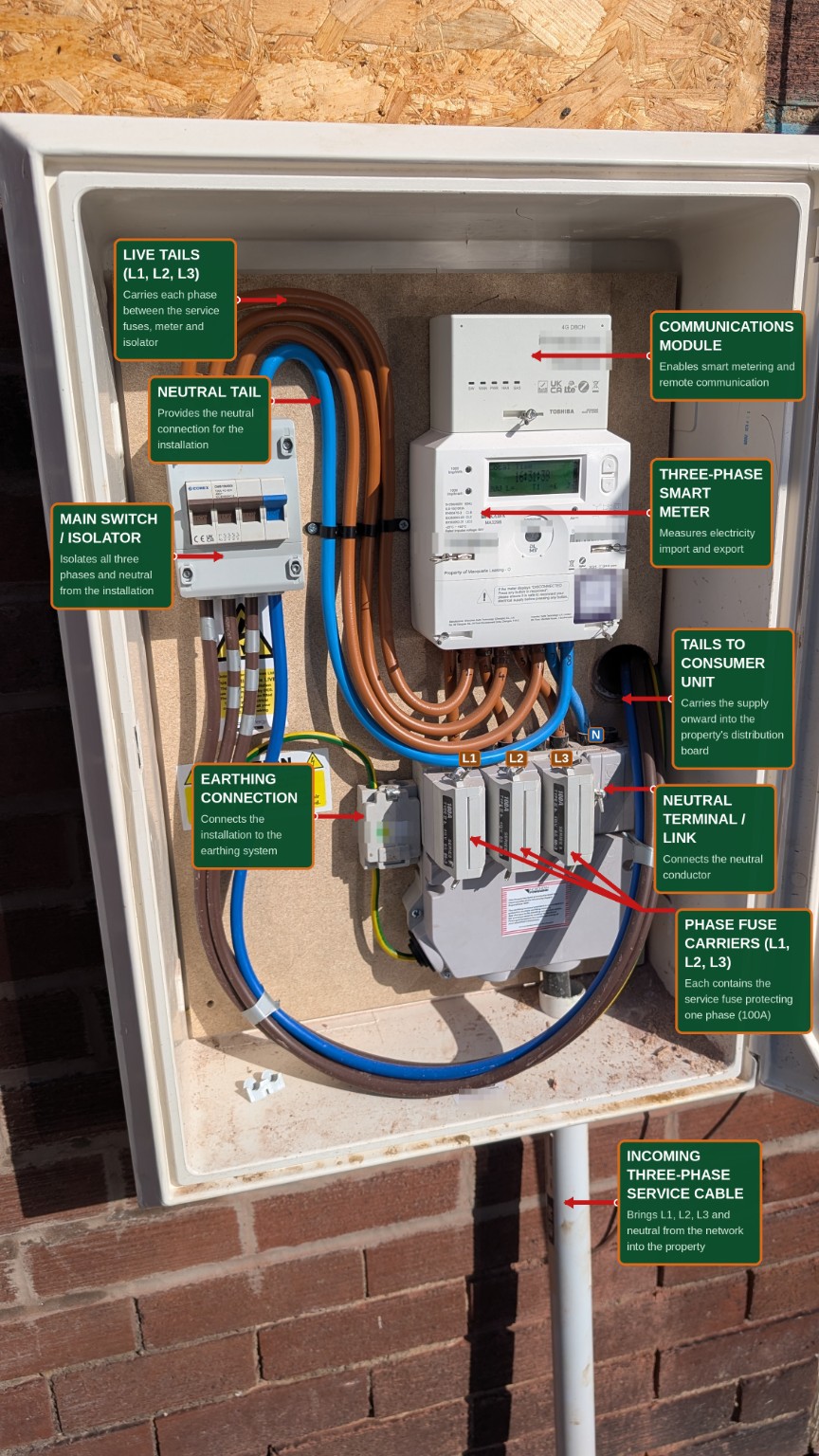
A three-phase supply includes three live wires, L1, L2 and L3, rather than one, together with one neutral. Each live conductor is protected by its own cut-out fuse. Three-phase fuses are commonly rated at up to 100 A per phase, although our Distribution Network Operator, Northern Powergrid, capped our connection at 80 A per phase. Each phase still supplies 230 V between live and neutral, so one phase can theoretically provide:
80 A × 230 V = 18.4 kW per phase
The total theoretical power available across all three phases is therefore:
3 phases × 18.4 kW per phase = 55.2 kW in total
4. Do we actually need that much electricity?
Probably not very often. To understand why a 13.8 kW connection might become insufficient, let us consider a worst-case scenario on a cold winter evening, when several of our electrical systems could be running at the same time.
At design stage our heat pump is currently sized to be 7 kW. We will talk about heat pumps and their sizing in a different journal entry, but importantly this rating refers to its heat output rather than its electrical consumption. Its electrical demand will vary depending on the outdoor temperature, the flow temperature and the operating conditions, and it will normally be substantially lower than the rated thermal output. However, the manufacturer specifies a maximum rated current of 15 A for the 230 V model, equivalent to a maximum electrical demand of 3.45 kW. We will use the maximum electrical demand from our heat pump in our calculations.
| Appliance / load | Maximum electrical demand |
|---|---|
| EV charger | 7.2 kW |
| Induction hob | 8.0 kW |
| Typical electric kettle | 2.4 kW |
| Microwave / oven | 1.8 kW |
| 7 kW heat pump | 3.45 kW |
| TOTAL | 22.85 kW |
| NEW THREE-PHASE CEILING | 55.2 kW |
As shown in this table, at maximum demand we would exceed the amount of electricity we can draw from the grid with our current 60 A single-phase cut-out fuse. However, the new three-phase ceiling would give us substantial headroom and allow us to add substantial electrical loads in the future. The maximum amount of electricity that we can import was not, however, the reason we decided to switch to three phase.
5. The real reason
The primary reason for our decision to switch to a three-phase supply is the export capacity. For our property, Northern Powergrid would permit a maximum export of 6.6 kW on the existing single-phase connection. For context, small generators of up to 16 A per phase (3.68 kW at 230 V) can usually connect under a notification process called G98. Anything larger requires approval under a different process called G99, with the maximum export capacity offered depending on the local network and the DNO's assessment of it. A single-phase supply can often be permitted to export more than the G98 threshold where the DNO approves it; in our case, Northern Powergrid offered up to 6.6 kW.
However, we designed our electrical systems to have capacity to export significantly more, allowing the house to support the grid precisely when demand is highest and work as a micro power plant. By exporting using all three separate phases, Northern Powergrid has now approved an export limit of 7 kW per phase, which gives us a total of 21 kW export capacity.
6. Why does 21 kW of export capacity matter?
Electricity does not have the same carbon intensity or value at every point in time on a typical day. The balance between supply and demand changes constantly, as does the generation mix supplying the grid. Weather, wind and solar generation all affect supply, while demand changes throughout the day. Our aim is to explore whether the house can generate, store and use electricity and export it back to the grid at the most useful times, in turn contributing to lower the carbon intensity of the grid.
This could mean charging the home battery or EV using our solar generation or when electricity is abundant, cheap or lower-carbon, then using that stored energy during periods of high demand.
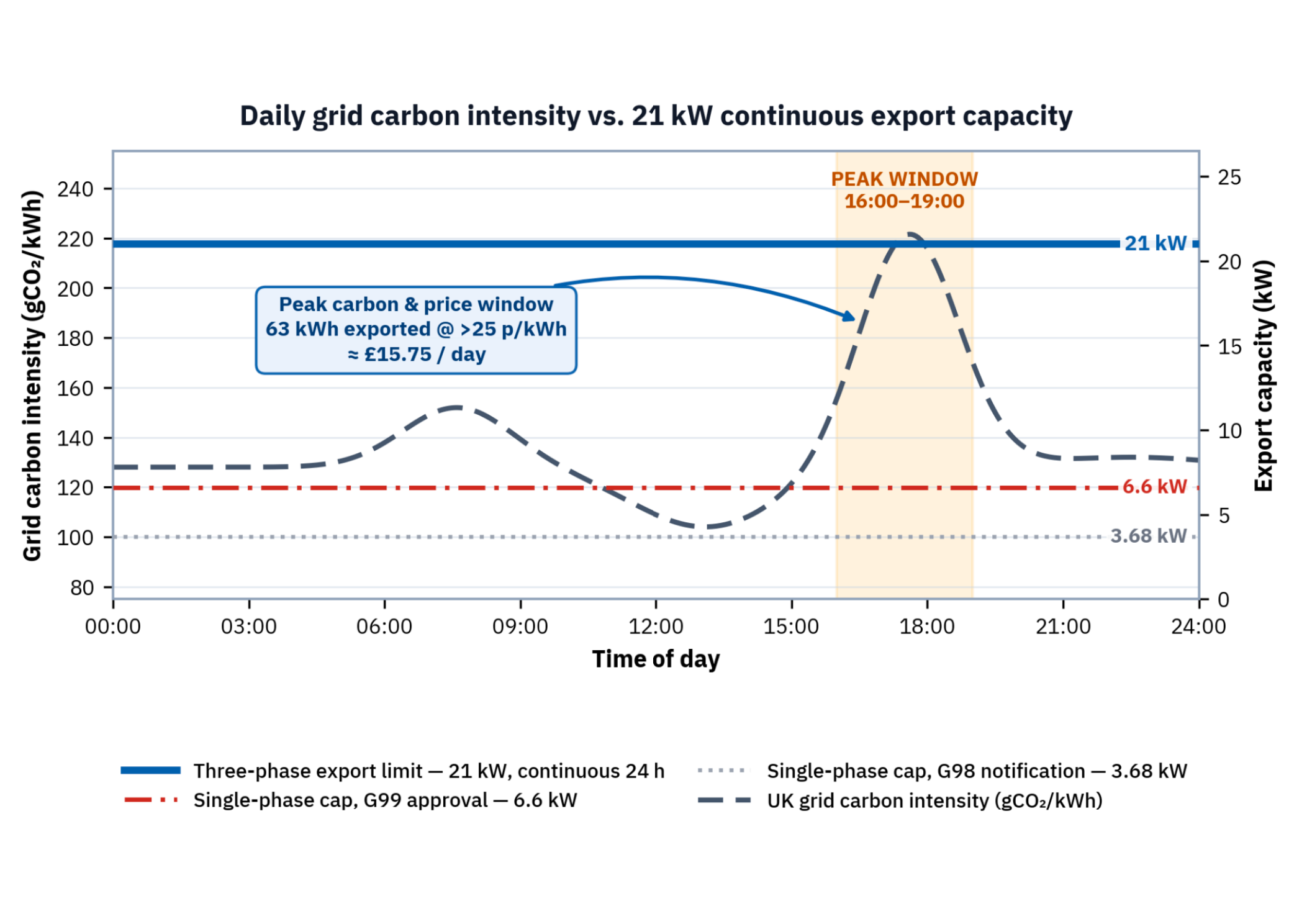
To illustrate the economics: at the time we were making this decision, some time-of-use export tariffs, such as Octopus Flux and Agile, offered rates of 25p per kWh or more during peak periods. If we were able to export at the full 21 kW limit continuously throughout a three-hour peak, we could theoretically export 63 kWh, which would be worth £15.75 at 25p per kWh. This is an illustrative scenario rather than expected revenue, and what we could actually achieve on a particular day would depend on the available solar generation, the amount of energy in storage, the power limits of our batteries and inverter, the state of charge of our EV and home batteries, and the export tariff available at the time.
Flexible tariffs make that capacity even more useful. Increasingly, the software controlling solar, battery and home-energy systems can automatically decide when to charge and discharge batteries in response to changing electricity prices, forecasts and household demand. Rather than us manually deciding when to buy or sell electricity, these systems can use optimisation algorithms and AI to import electricity when it is cheap, store it, and export stored energy when electricity is more valuable.
Financially, this creates an opportunity to increase the value obtained from the same solar panels and batteries: buying electricity during cheaper periods and exporting during more expensive ones can improve the economics of the system and potentially shorten its payback period. There is also a significant environmental benefit. Electricity prices and grid carbon intensity are not directly proportional, but they are often influenced by some of the same underlying conditions. Periods of abundant renewable generation can coincide with lower wholesale prices and lower carbon intensity, while periods of high demand and lower renewable output can require more expensive and more carbon-intensive generation. Shifting some of our electricity consumption towards the former and our exports towards the latter can therefore contribute to reducing emissions as well as costs.
This is one of the main reasons the 21 kW export limit matters to us. We are not planning to manually watch electricity prices and decide when to charge and discharge batteries every day. The aim is for the energy-management software to optimise those decisions automatically, while we measure what actually happens. Once the system is operational, we will be able to compare the theoretical benefit with our real import prices, export prices, battery behaviour and grid carbon intensity.
7. Why was the decision surprisingly inexpensive?
We needed to do something about our electrics. We needed to either change only the old cut-out fuse, move the electrics as well as changing the fuse, or move the electrics while also switching to three phase. We initially obtained quotes for the first two options. However, when we looked at the network maps for our area, we realised that just outside our boundary the street carried a supply capable of delivering three-phase electricity to our house, which we knew would make the switch far cheaper. Northern Powergrid still needed to confirm that there was sufficient capacity on their equipment further away from the house, and thankfully there was. The table below details the cost for each option.
| Option | Scope | Cost |
|---|---|---|
| Option 1 | Renew cut-out fuse but keep the electrics in the same location within the house | Free of charge |
| Option 2 | Relocate single-phase supply as well as renewing the cut-out fuse. Cost includes all groundworks within our boundary and on the street | £1,200 |
| Option 3 | Relocate the electrics and switch to a three-phase supply. Cost includes groundworks on the street and the new connection | £2,500 |
| Private groundworks | Site trenching within our boundary (900 mm deep × 300 mm wide × 6 m long) and laying rigid duct | £600 |
| TOTAL INVESTMENT | Complete Three-Phase Switch & Relocation | £3,100 |
| NET DIFFERENCE COST | Upgrade Premium over standard single-phase relocation | ~£1,900 |
In summary, the difference between keeping a single-phase supply but relocating it and switching to a three-phase supply was £1,900. We felt this was one of the easiest decisions to make, as we would be getting a significantly improved supply and future-proofing ourselves. It is worth saying that these were the costs quoted for our particular property and network connection, and they should not be taken as representative pricing for a three-phase upgrade elsewhere. The figures could easily run into the tens of thousands to switch to a three-phase supply. The single biggest factor in our favour was that a three-phase-capable supply already ran within a metre of our boundary.
8. Getting three-phase into the house
For anyone considering the same upgrade, this is how the process unfolded, step by step:
- We established what we had: a 60 A single-phase supply, with the service head sitting in the future ground-floor toilet.
- We contacted Northern Powergrid, who offered to replace the ageing cut-out free of charge in its existing position, or to relocate the single-phase supply for £1,200 including the street and private groundworks.
- We checked the network maps and spotted a three-phase-capable supply running just outside our boundary.
- Northern Powergrid assessed and confirmed the capacity on their network further upstream, and quoted £2,500 to upgrade and relocate the supply, excluding the groundworks on our land.
- We agreed the new service position on the front elevation, beside the front door.
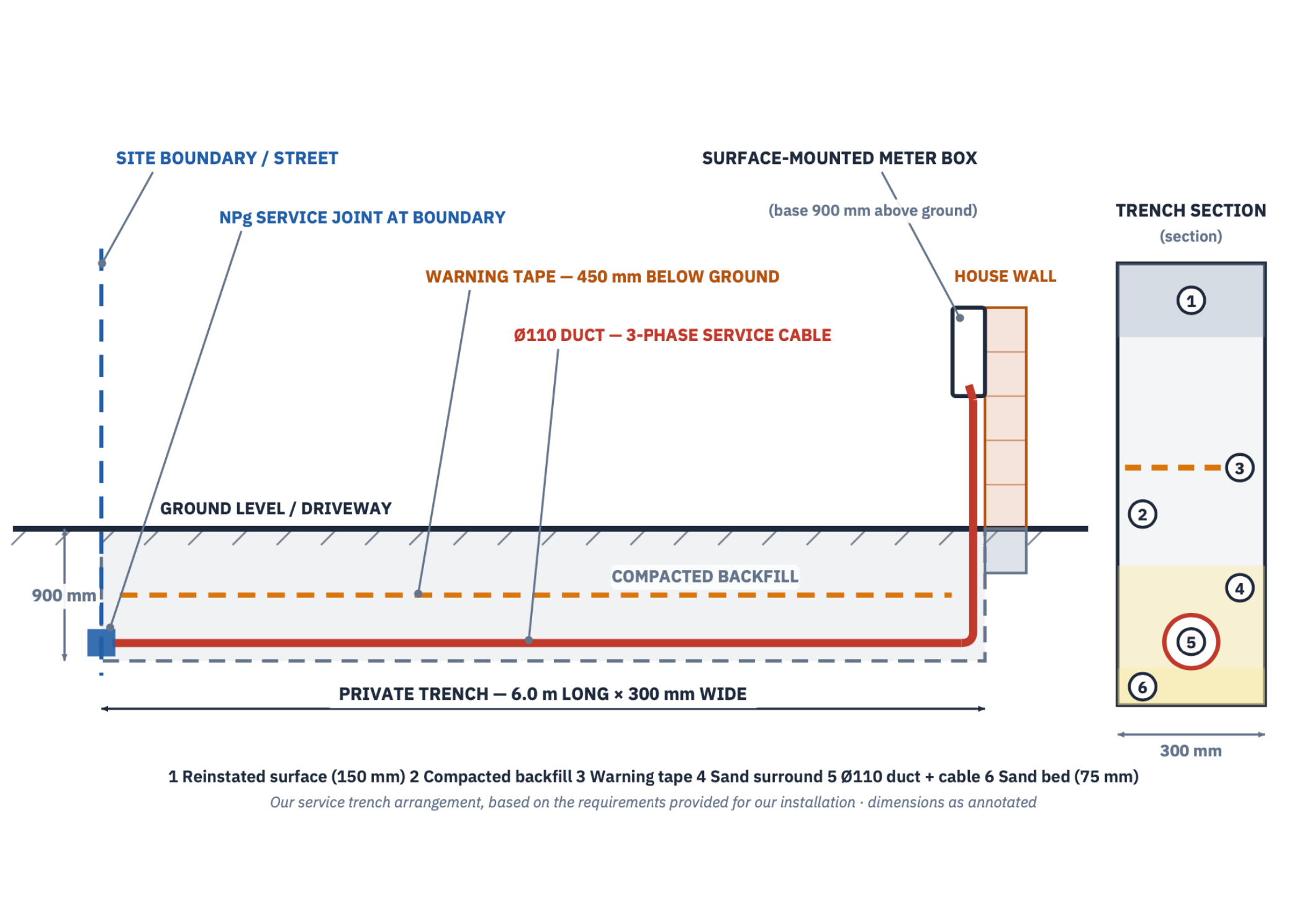
- We arranged the private groundworks: 900 mm deep, 300 mm wide and 6 m long, with ducting laid to the DNO's specification, at a cost of £600.
- Northern Powergrid then pulled in the new service cable and installed the three-phase cut-outs at the new position.
- Our electricity supplier installed the three-phase meter and isolator.
- Our electrician installed the three-phase consumer unit and connected it to the three-phase isolator.
- We completed the G99 application and were approved for 7 kW export per phase.
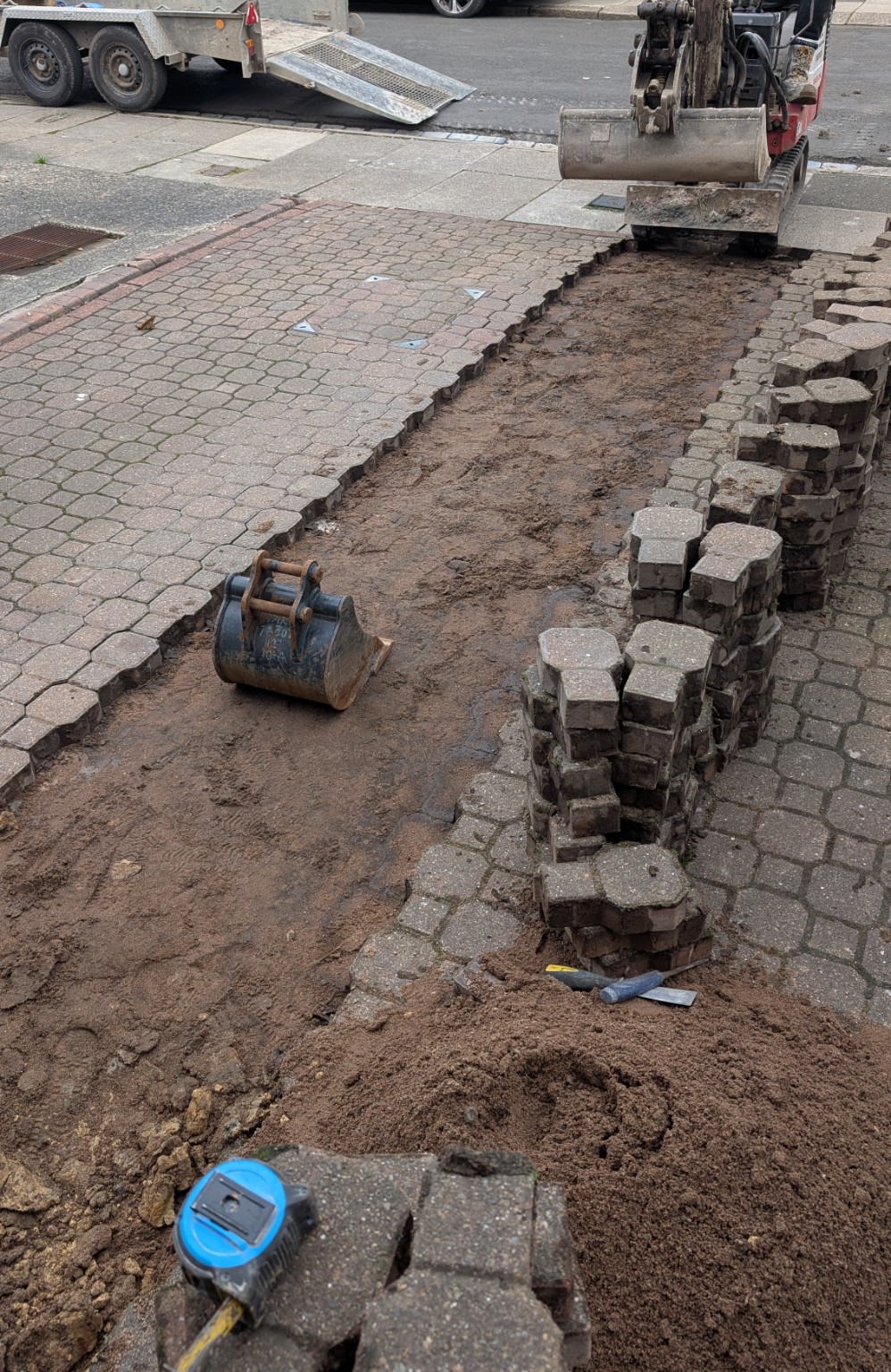
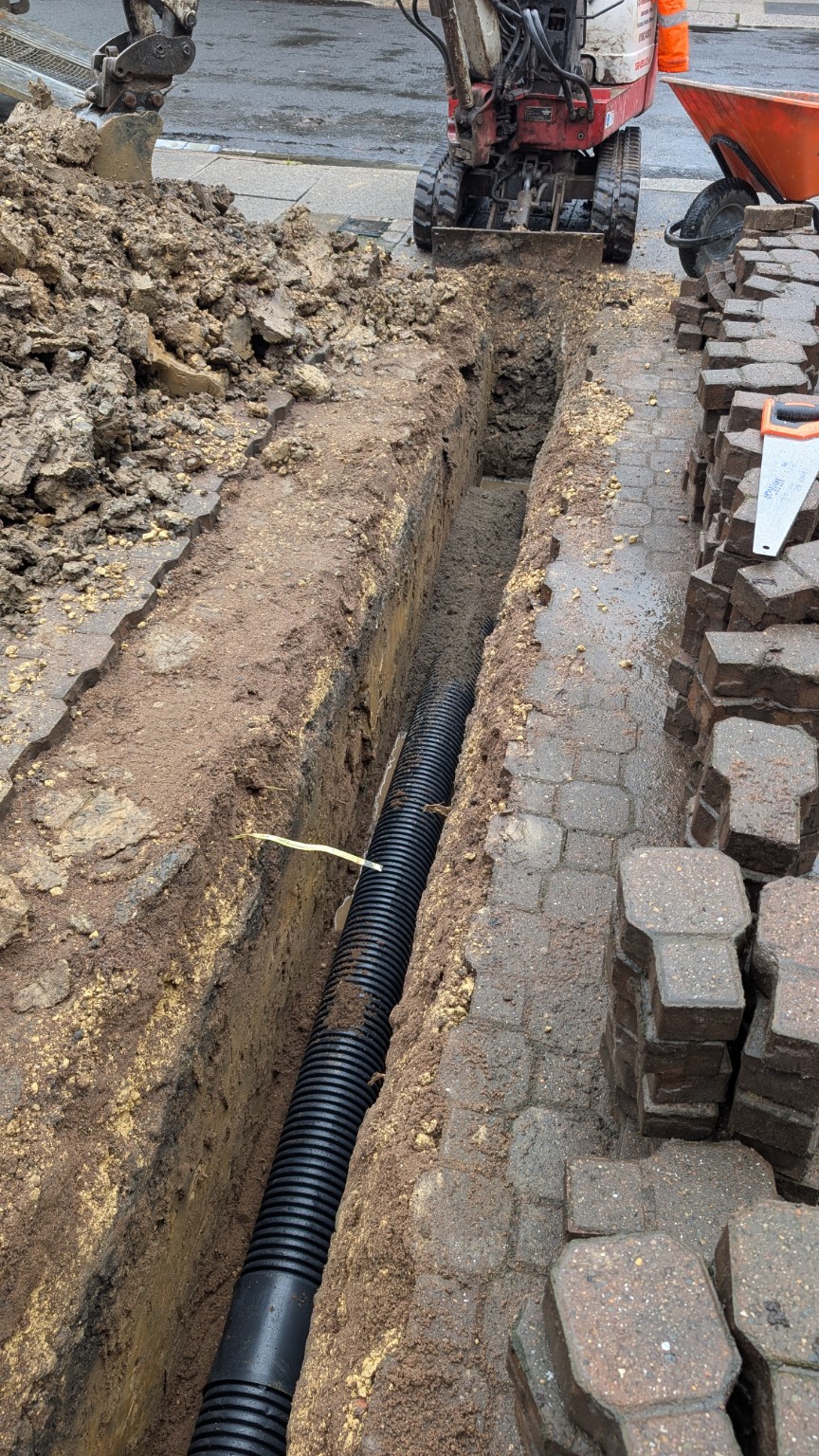
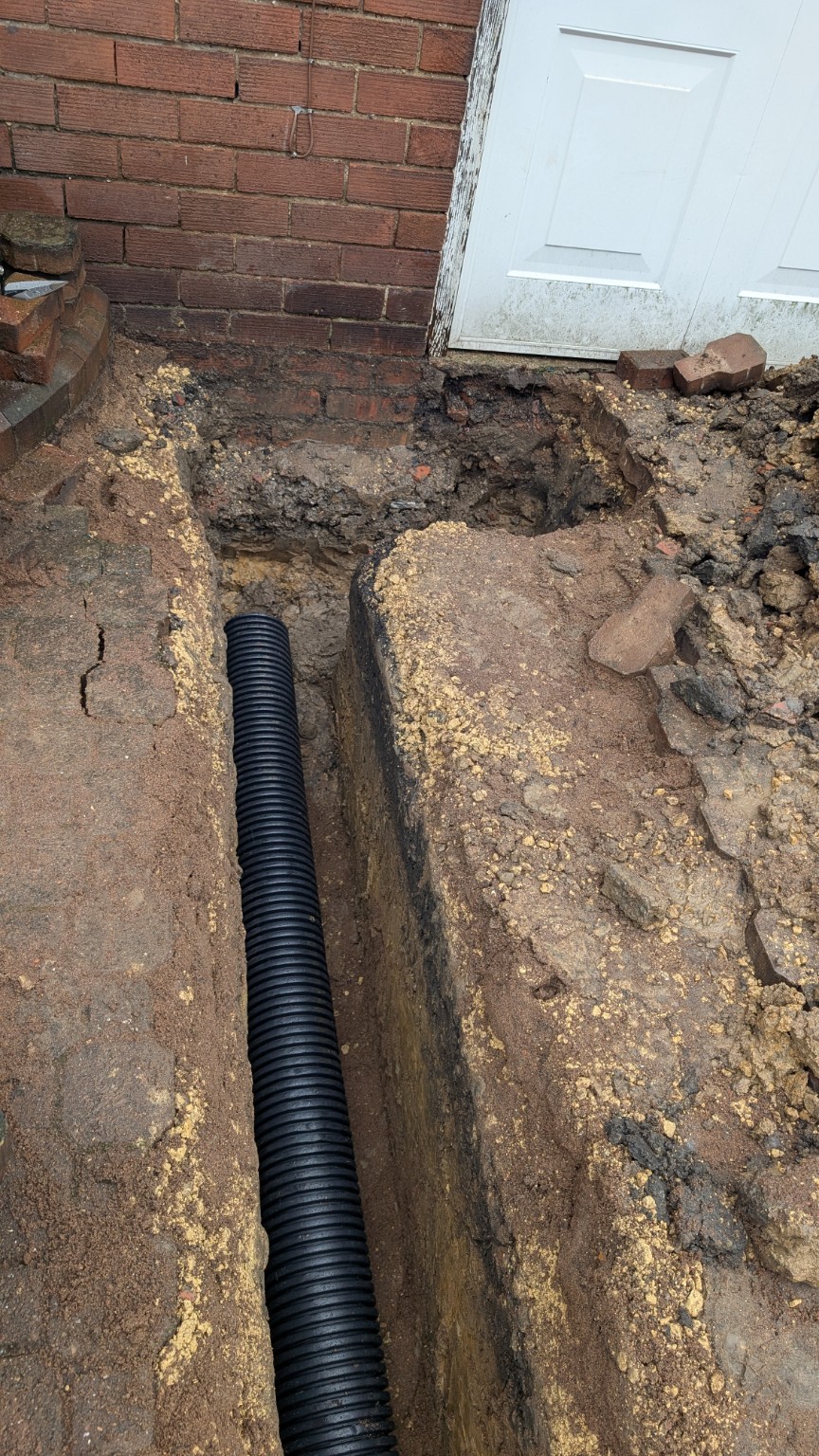
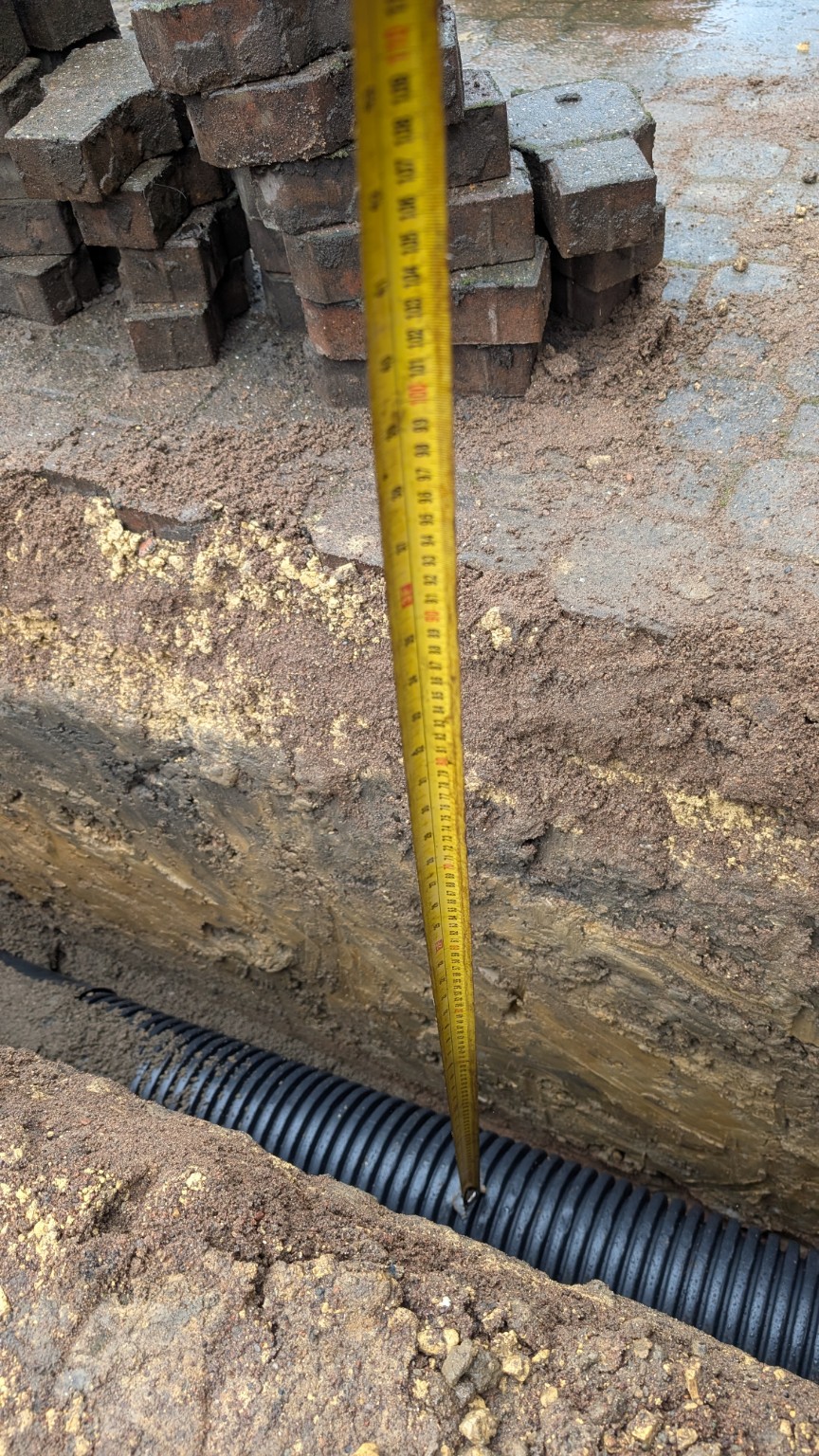
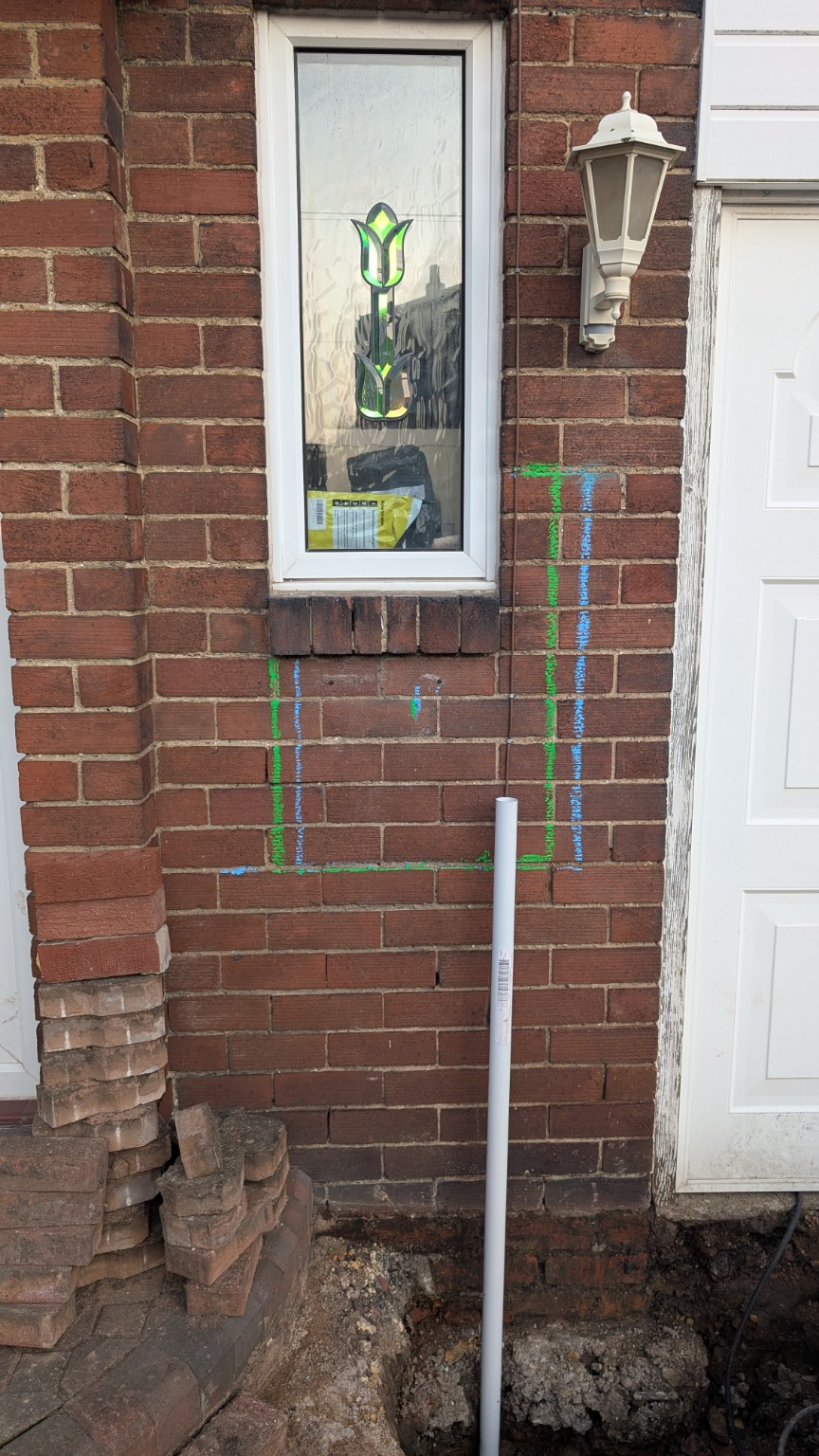
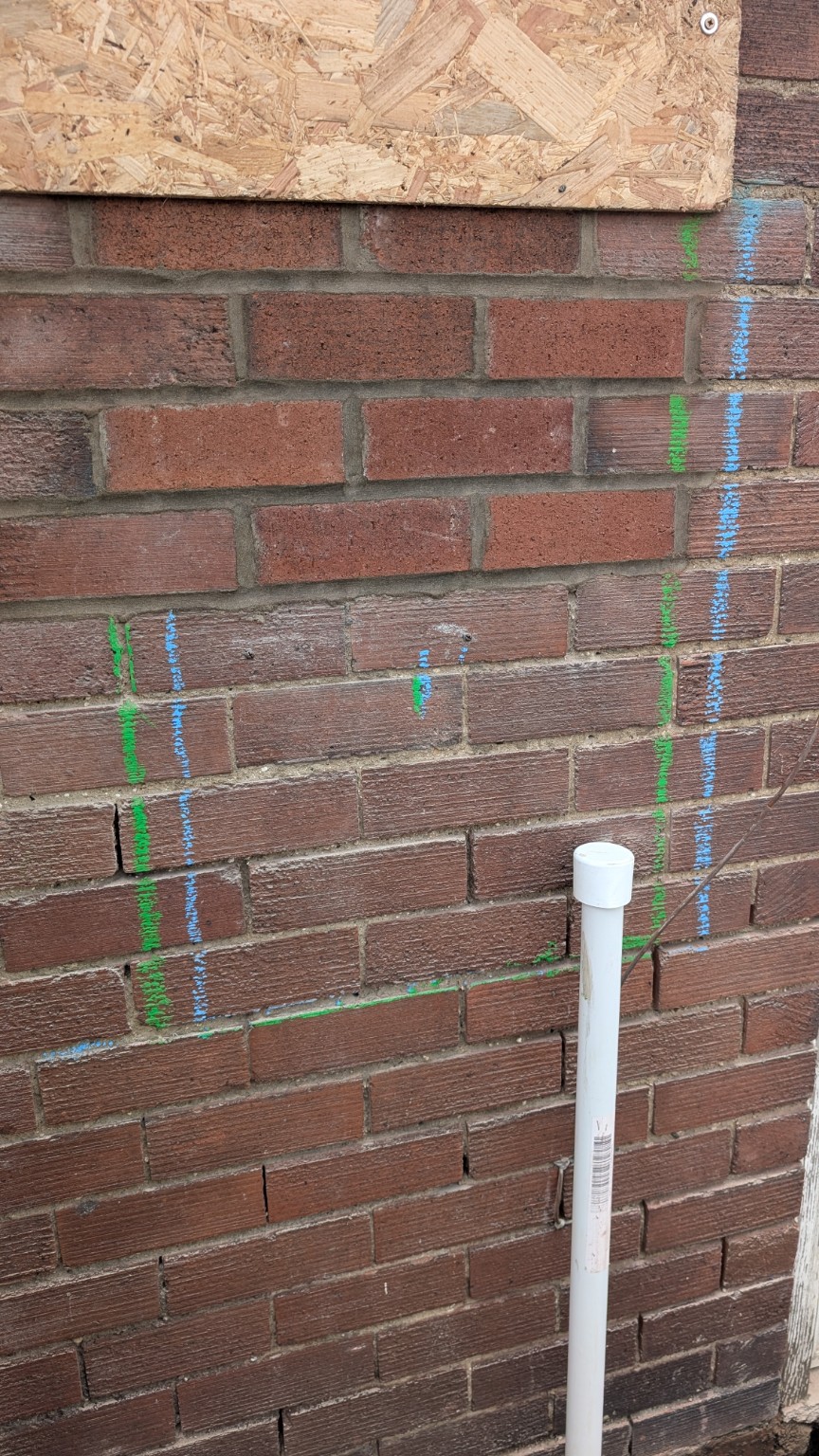
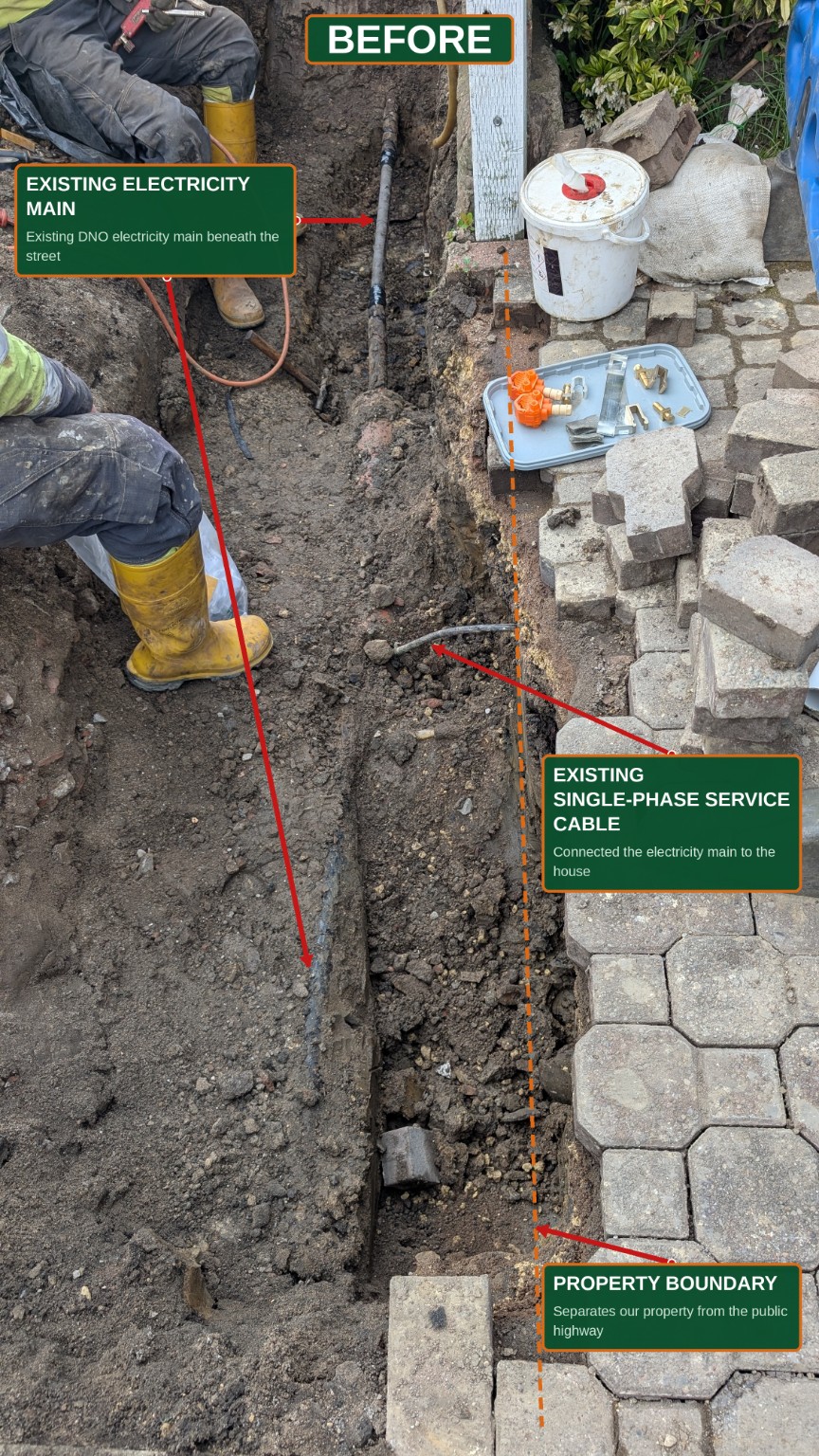
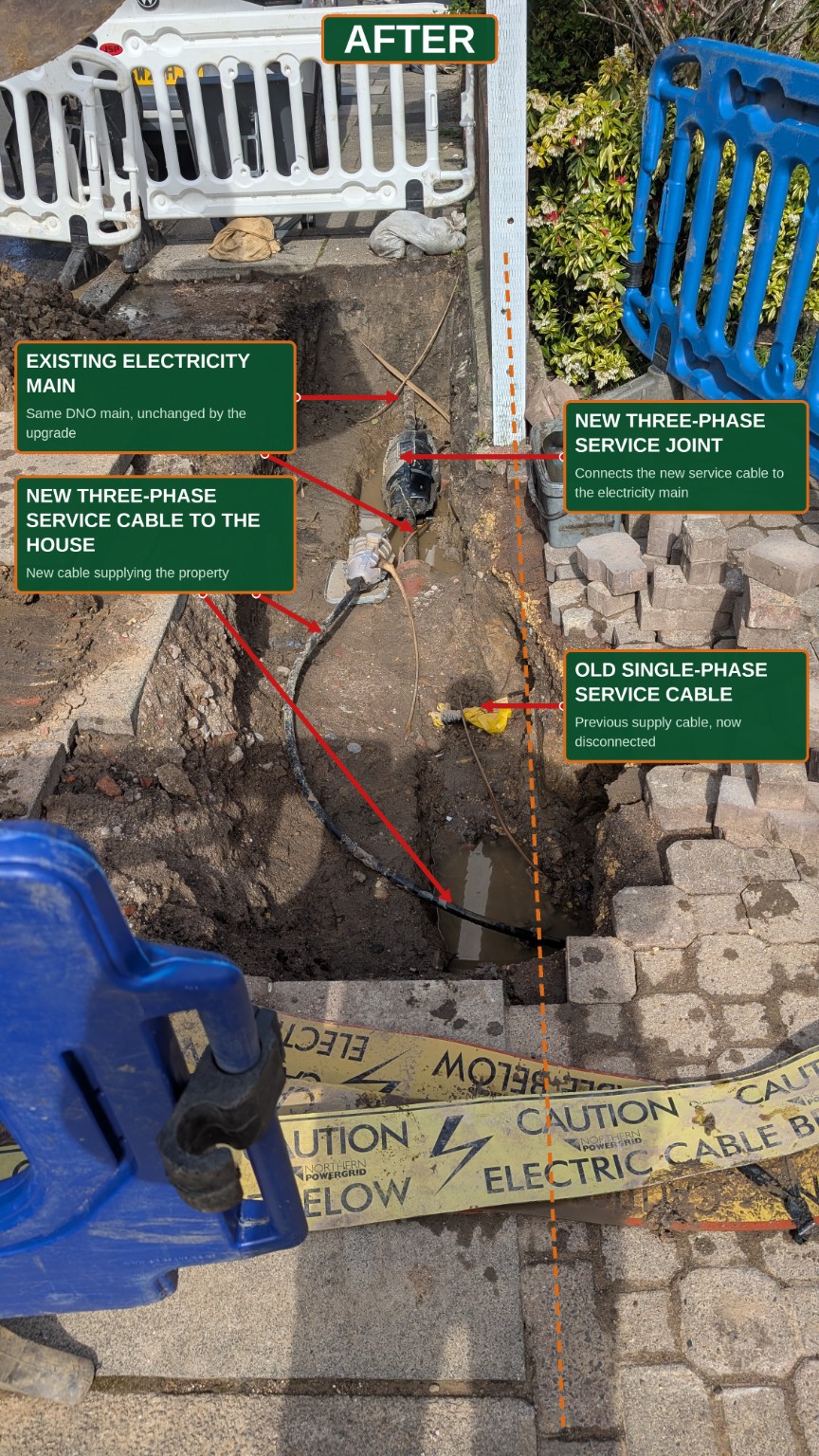
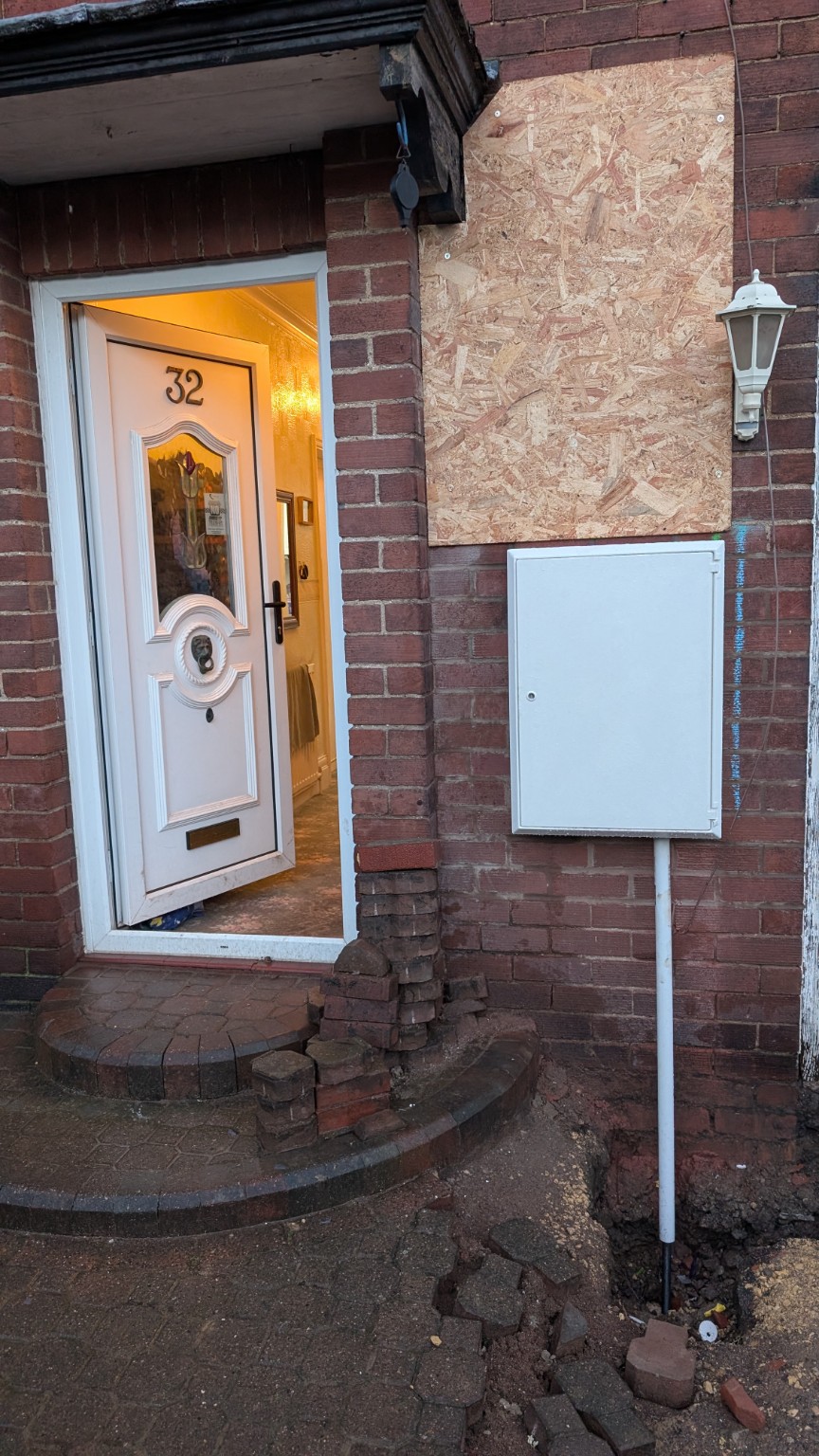
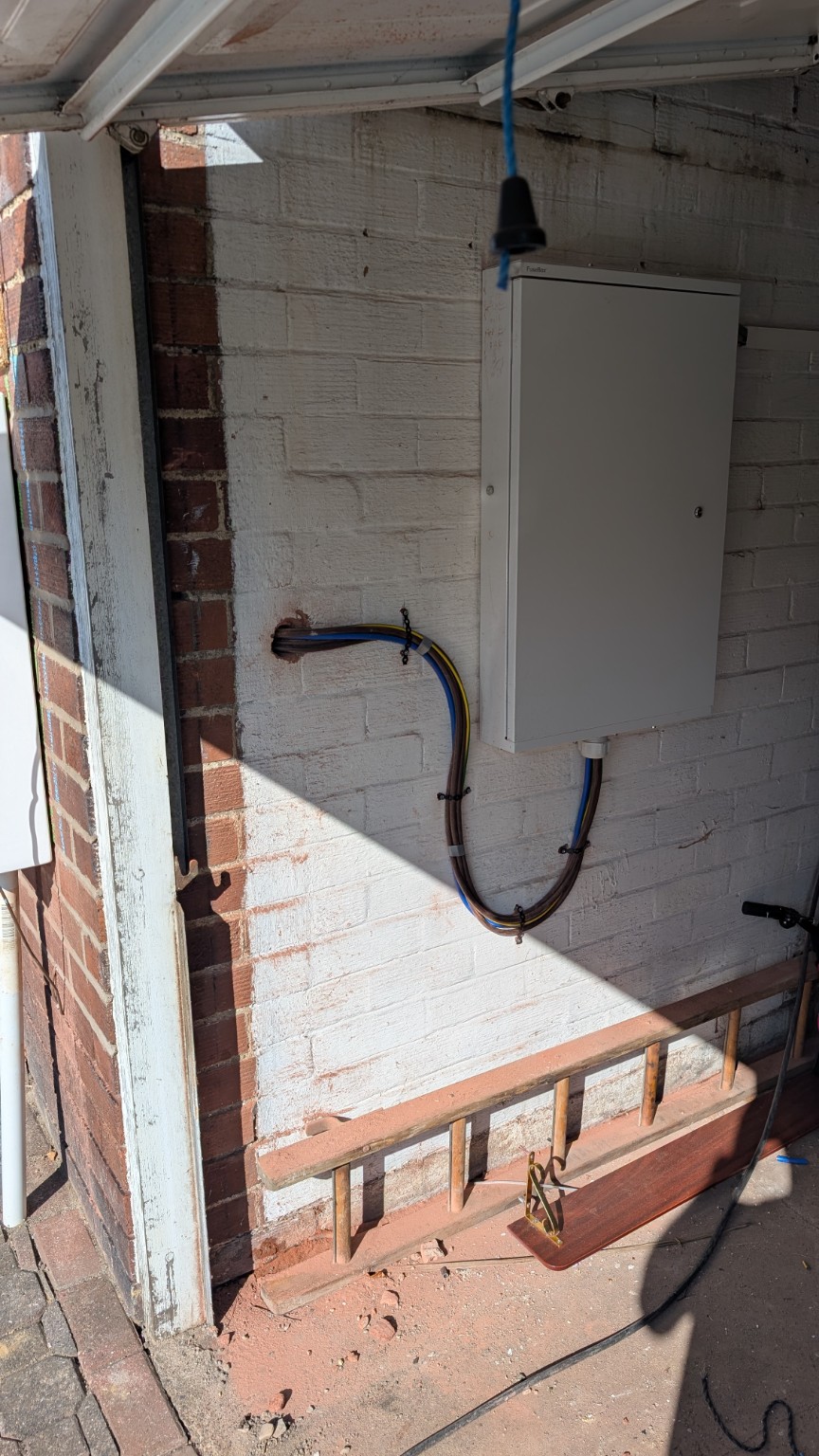
The diagram below shows the physical arrangement of the groundworks. The 6 m private trench runs from the Northern Powergrid service joint at the site boundary to the new meter position on the front elevation of the house.
9. Where do you put a meter box in a deep retrofit?
A lot of thinking went into where the new meter box should go. Ideally we would have liked it inside the current garage, which will become the side extension. However, that would have meant running the new cable from the street very close to our existing drainage and sewage pipes, and we wanted to avoid digging a trench near those. It would also have required penetrating the ground-floor slab, which carries a risk of thermal bridging and airtightness disruption.
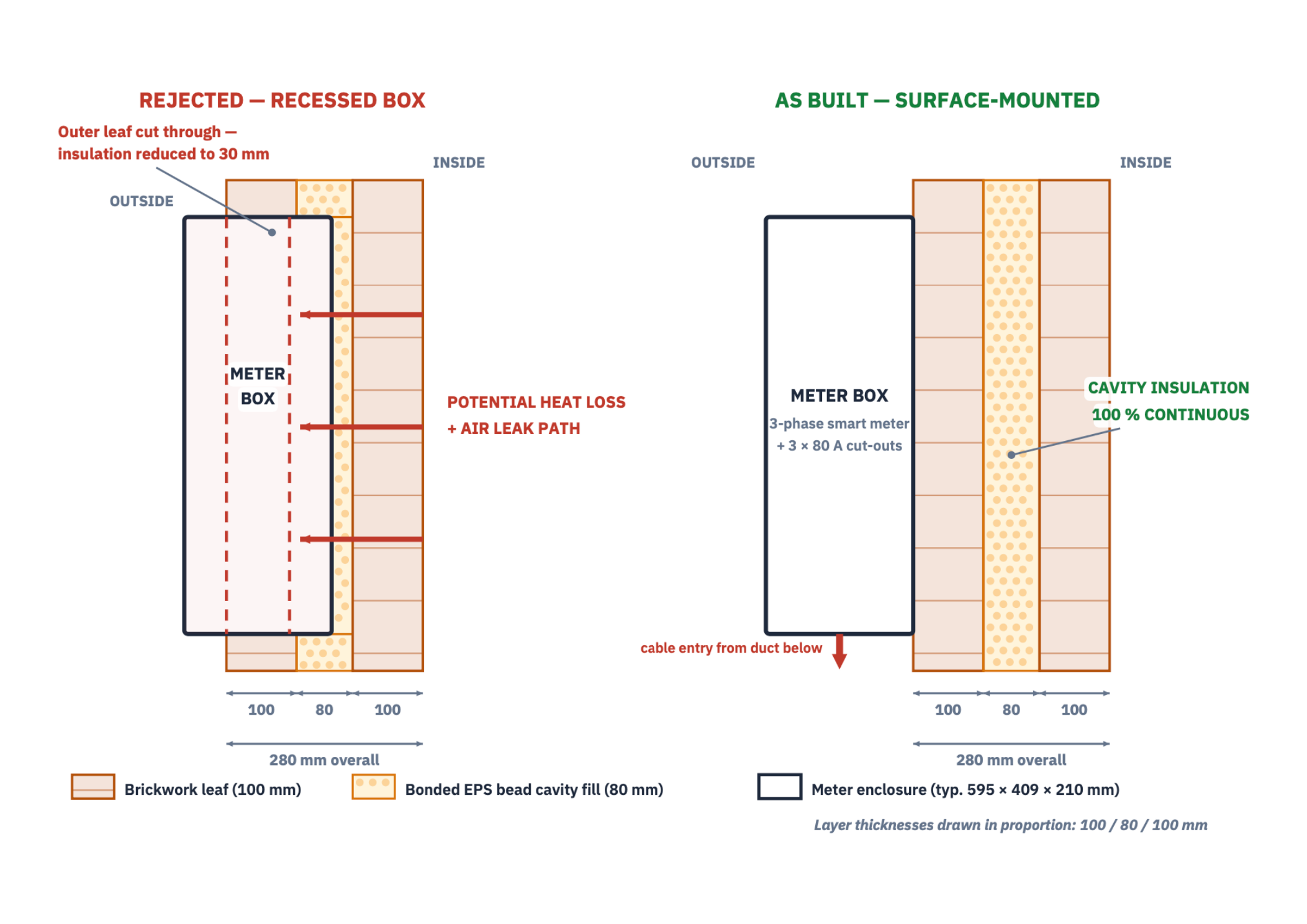
So we kept it very simple: the meter box sits on the outside front elevation next to the front door, and the electric cable from the street runs under the drive to reach it. That left us with one final question: should the electric box be recessed into the wall or mounted on its surface? A recessed box would interrupt the outer brick leaf, with part of it sitting within the cavity, in turn reducing the continuity of the cavity insulation locally. This would introduce junctions with a higher risk of cold spots and condensation. We therefore decided to install a surface wall-mounted meter box to preserve the front-elevation cavity intact for its bonded bead insulation fill.
10. Does everything now need three-phase power?
No. This was something we had to get our heads around. Having a three-phase supply does not mean that ordinary household appliances need three-phase power. Most of our house will still operate on conventional 230 V single-phase circuits, including the heat pump, which is available in three-phase versions but which we specified as single-phase. Our electrician will distribute those circuits across the three phases to balance the electrical load. The equipment specifically designed around our three-phase infrastructure will principally be the solar PV, battery and EV charging system.
11. Was it worth it?
For £1,900 more than the work we already needed to undertake, we increased our theoretical import capacity from 13.8 kW to 55.2 kW and our approved export capacity from 6.6 kW to 21 kW, while creating electrical infrastructure with considerable capacity for the future. On paper it looks like one of the better-value decisions in the retrofit, but that is still only the theory, and the important question is whether we actually use the additional capacity and whether the export opportunity delivers the financial and carbon benefits we expect.
WHY WE DID IT
£1,900incremental cost over relocating single-phase
13.8 → 55.2 kWtheoretical maximum import capacity
6.6 → 21 kWapproved export capacity
3 phasesfuture-ready electrical infrastructure
Decision summary
Should we upgrade the house from a single-phase to a three-phase electricity supply?
Upgrade to three-phase while relocating the service head, with 80 A per phase and G99 export approval at 7 kW per phase.
The upgrade increases theoretical import capacity from 13.8 kW to 55.2 kW and approved export capacity from 6.6 kW to 21 kW for an incremental cost of roughly £1,900. It also gives our solar, battery and EV system substantially more headroom to respond to flexible tariffs, allowing energy-management software to shift imports towards cheaper periods and exports towards higher-value periods. Where those periods also correspond with changes in grid carbon intensity, the same flexibility may provide a carbon benefit as well as improving the financial return.
Decision made and three-phase supply installed. The real-world import, export, generation, storage, financial and carbon performance is still to be measured.
Electrical Infrastructure & Grid Connection